
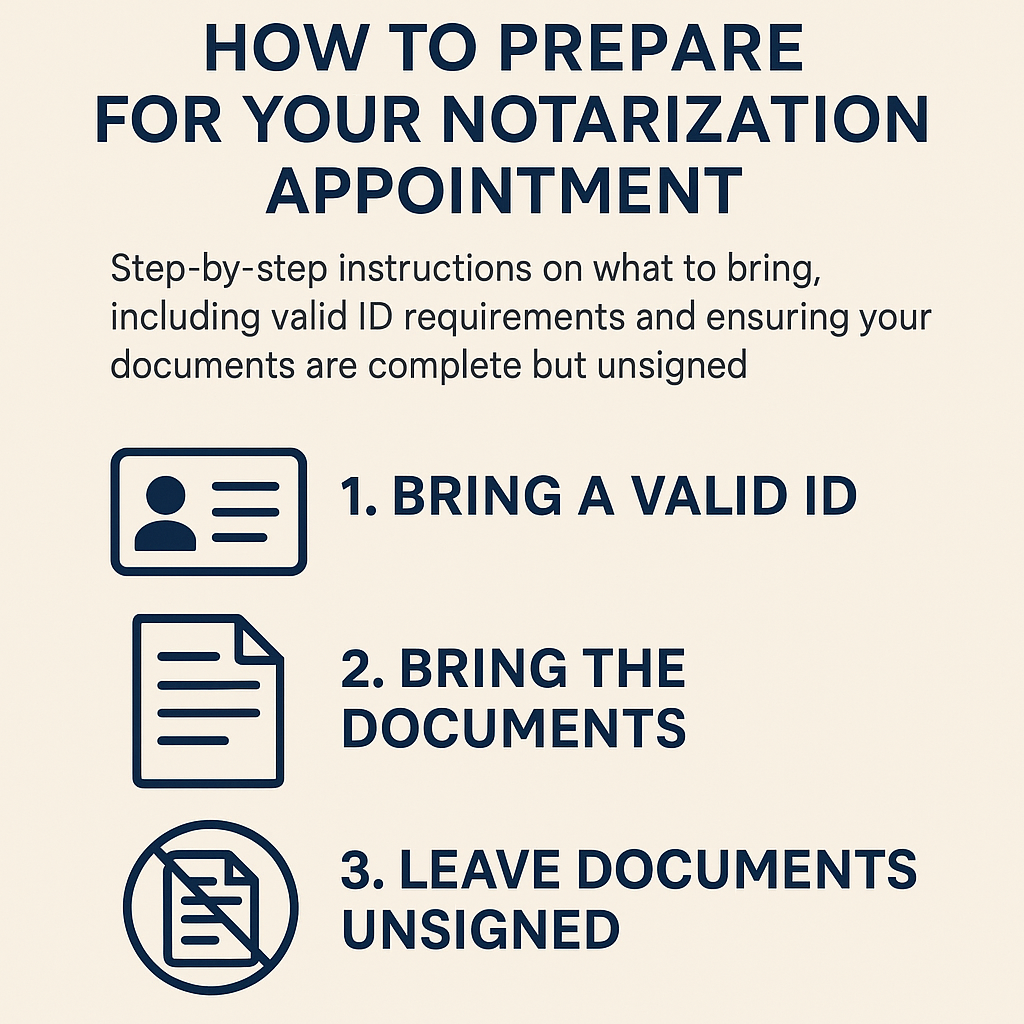
How to Prepare for Your Notarization Appointment
Preparing properly for your notarization appointment ensures a smooth, efficient process and helps avoid delays or the need to reschedule. Whether you’re notarizing a power of attorney, deed, affidavit, or other important document, following these step-by-step instructions will help you arrive ready.
Step 1: Bring Valid Identification
According to the California Notary Public Handbook, the notary public must establish your identity through “satisfactory evidence.” This means you’ll need to present acceptable identification documents.
Primary Forms of ID (Current or Issued Within 5 Years)
- California driver’s license or ID card issued by the California Department of Motor Vehicles
- U.S. passport or U.S. passport card
- Inmate identification card issued by the California Department of Corrections and Rehabilitation (if applicable)
- Inmate identification issued by a sheriff’s department (if applicable)
Secondary Forms of ID (Must Include Photo, Description, Signature, and ID Number)
- Valid consular identification document from your country of citizenship
- Valid passport from your country of citizenship
- Driver’s license issued by another U.S. state, Canadian, or Mexican agency
- Identification card issued by another state
- U.S. military identification card
- Employee ID card issued by a California state, city, or county agency
- Identification card issued by a federally recognized tribal government
Important: The notary will record details from your ID in their official journal, including the type of document, issuing agency, serial number, and expiration date.
Step 2: Ensure Your Documents Are Complete but Unsigned
One of the most critical requirements outlined in the California Notary Public Handbook is that documents must be complete before notarization. According to Government Code section 8205, “A notary public may not notarize a document that is incomplete.”
What “Complete” Means
- All blanks filled in: Every required field should be completed with the appropriate information
- No missing pages: The entire document should be present
- Correct notarial certificate: The proper acknowledgment or jurat form should be attached or included
- All parties identified: Names, dates, and other essential information should be clearly stated
What “Unsigned” Means (It Depends on the Notarial Act)
The signing requirements depend on the type of notarization:
- For Acknowledgments: You may sign the document before your appointment. The notary will verify your identity and confirm that you acknowledge executing the document
- For Jurats: You must sign the document in the notary’s presence after taking an oath or affirmation about the document’s truthfulness
Best Practice: When in doubt, bring your documents unsigned and ask the notary which type of notarization is required. This prevents the need to redo paperwork.
Step 3: Know What Type of Notarization You Need
Understanding the difference between notarial acts helps ensure you have the correct certificate attached to your document.
Acknowledgment
Used when you need to confirm that you willingly signed a document. The notary certifies:
- That you personally appeared before them
- Your identity through satisfactory evidence
- That you acknowledged executing the document
Common for: Deeds, powers of attorney, deeds of trust, contracts
Jurat
Used when you need to swear or affirm that the contents of a document are true. The notary certifies:
- That you personally appeared before them
- That you signed the document in their presence
- That you took an oath or affirmation
- Your identity through satisfactory evidence
Common for: Affidavits, declarations under penalty of perjury
Step 4: Be Prepared to Provide a Thumbprint (for Certain Documents)
According to the California Notary Public Handbook, if your document is a deed, quitclaim deed, deed of trust, other document affecting real property, or a power of attorney, the notary must obtain your right thumbprint in their journal.
If your right thumbprint is unavailable, the notary will use your left thumb or any available finger. If you’re physically unable to provide any fingerprint, the notary will note this in their journal with an explanation.
Step 5: Bring All Signers (If Applicable)
All persons whose signatures require notarization must personally appear before the notary. The California Notary Public Handbook is clear: “A video image or other form of non-physical representation is not a personal appearance in front of a notary public under California State law.”
This means:
- Remote notarization (via video) is not currently available for most California notarizations
- You cannot have someone appear on your behalf (with limited exceptions for subscribing witnesses)
- All parties must be physically present at the same time
Step 6: Understand the Fees
California law sets maximum fees for notarial services. According to Government Code section 8211:
- Acknowledgments: Maximum $15 per signature
- Jurats: Maximum $15
- Oaths/Affirmations: Maximum $15
- Certified copies of powers of attorney: Maximum $15
The notary may charge less than these amounts or provide services for free. Travel fees, if any, should be identified separately.
Step 7: Review Your Documents One More Time
Before your appointment, double-check:
- [ ] All required information is filled in
- [ ] You have the correct notarial certificate attached (acknowledgment or jurat)
- [ ] You know which type of notarization you need
- [ ] You have valid, acceptable identification
- [ ] All parties who need to sign will be present
- [ ] You understand whether to sign before or during the appointment
- [ ] Your documents include all pages
Common Mistakes to Avoid
- Arriving with incomplete documents: The notary cannot proceed if required information is missing
- Signing a jurat document beforehand: This requires you to sign in the notary’s presence
- Bringing expired ID: Most IDs must be current or issued within the last 5 years
- Expecting the notary to provide legal advice: California notaries cannot prepare legal documents, give legal advice, or determine which type of notarization you need
- Assuming all notarizations are the same: Requirements differ between acknowledgments and jurats
What Happens During the Appointment
Understanding the notary’s process helps you know what to expect:
- The notary will ask to see your identification and examine it carefully
- The notary will record information in their official sequential journal, including your signature
- For real property documents and powers of attorney, the notary will obtain your thumbprint in their journal
- For jurats, the notary will administer an oath or affirmation, and you’ll sign in their presence
- For acknowledgments, the notary will confirm that you acknowledge executing the document
- The notary will complete the certificate, sign it, and affix their official seal
After the Notarization
Once complete, you’ll receive your notarized documents. The notary’s certificate and seal confirm that:
- You appeared before the notary on the date specified
- Your identity was established through satisfactory evidence
- You acknowledged executing the document (acknowledgment) or signed and swore to it in their presence (jurat)
Important Note: As stated in the California Notary Public Handbook, “A notary public or other officer completing this certificate verifies only the identity of the individual who signed the document to which this certificate is attached, and not the truthfulness, accuracy, or validity of that document.”
Special Situations
If You Don’t Have Acceptable ID
The California Notary Public Handbook provides for the use of credible witnesses if you cannot provide acceptable identification. A credible witness personally known to the notary can vouch for your identity under oath, provided certain conditions are met. Discuss this option with your notary in advance.
If You’re Signing by Mark
If you cannot write your name, you may sign by making a mark. This requires two witnesses to observe you make your mark, and the notary will have specific procedures to follow as outlined in Civil Code section 14.
Certifying Copies
California notaries can only certify copies of powers of attorney. They cannot certify copies of vital records (birth certificates, death certificates, marriage licenses) or most other documents. For powers of attorney, the notary will examine the original and certify that the copy is accurate.
Conclusion
Proper preparation makes your notarization appointment quick and successful. By bringing valid identification, ensuring your documents are complete (but properly unsigned based on the type of notarization), and understanding the process, you’ll avoid delays and ensure your important documents are notarized correctly according to California law.
For additional information, consult the California Notary Public Handbook or contact a qualified California notary public with any questions about your specific situation.