
A Bedside Signing at Kaiser Ontario the Day Before Surgery: What a Hospital Notary Near Me Call Actually Looks Like
Most people search for a hospital notary near me at the worst possible moment. It is not during business hours when everything is calm. Instead, they search when a family member just got a diagnosis, when surgery is tomorrow morning, and when nobody in the room has a plan for what happens if things go wrong.
That is exactly the call I got on a weekday afternoon. A family at Kaiser Permanente Ontario Medical Center needed two documents notarized before their brother went into surgery the next day. He had cancer. His brother and sister-in-law had flown in from out of town. Unfortunately, nobody had a power of attorney in place. More importantly, nobody had an advance health care directive either. And the clock was already running.
I am Brent with Wet Ink Notary, a California-commissioned mobile notary based in Upland. As a result of that call, I drove to Kaiser Ontario that afternoon. This is the story of what happened, what almost went wrong, and why families in this situation need a hospital notary near me who knows California law cold.
Call (626) 248-0349 if you are in this situation right now.
The Call: Why Families Wait Until the Last Day
Here is something most people do not realize until it is almost too late. Hospitals do not prepare your legal documents for you. Doctors will tell you that surgery is scheduled for tomorrow morning. Nurses will hand you a stack of medical consent forms. However, nobody in that hospital is going to ask whether you have a power of attorney or an advance health care directive on file.
That is how this family ended up calling me. The patient, their brother, had been dealing with cancer. Surgery was set for the following day. Meanwhile, his brother and sister-in-law had traveled from out of state to be there. Somewhere in the conversation, someone in the room asked the question every family should ask before surgery: what happens if he cannot make decisions for himself afterward?
The answer was nothing. No POA. No health care directive. In other words, no legal authority for anyone in that room to act on his behalf. Consequently, they searched for a hospital notary near me and found Wet Ink Notary.
I was at Kaiser Ontario within the hour.
What They Needed: Two Documents Before the Morning
The family needed two documents notarized before the end of the day.
The first was a Power of Attorney This would authorize a trusted family member to handle financial decisions, pay bills, manage bank accounts, and deal with insurance if the patient was incapacitated after surgery. Without this document, the family would have had to petition the Probate Court for a conservatorship. That process takes weeks or months and costs thousands of dollars, all while medical bills pile up.
The second was a California Advance Health Care Directive. This is the document that names a health care agent to make medical decisions and records the patient’s treatment wishes. Under California Probate Code section 4701, an advance directive can be either notarized or witnessed by two qualified adults. The family chose notarization because hospitals process a notarized directive faster. Additionally, they did not have time to find two qualifying witnesses who were not family members.
Both documents had to be signed that afternoon. Not tomorrow. Not after surgery. Right then.
The Expired ID Problem That Almost Stopped Everything
When I walked into the hospital room, I introduced myself and asked for identification. The patient handed me a California driver’s license. It was expired.
In most states, this would have ended the appointment immediately. However, California law has a specific rule that most notaries and most families do not know about. Under California Government Code section 8230, a California driver’s license or identification card is acceptable for notarization as long as it was issued within the last five years, even if the expiration date has passed.
I checked the issue date right there at the bedside. Fortunately, it was within the five-year window. As a result, the ID was valid for notarization purposes.
This is the kind of moment that separates a hospital notary near me who knows the law from one who does not. A less experienced notary might have looked at the expiration date, apologized, and walked out. That family would have spent the rest of the afternoon scrambling to figure out how to get a current ID for a cancer patient who was scheduled for surgery in the morning. Obviously, that was not going to happen. If you are worried about identification, read our guide on ID Questions about what to do when you do not have valid ID but need something notarized.
I confirmed the ID, opened my notary journal, and we got to work.
Inside the Hospital Room: Assessing the Patient
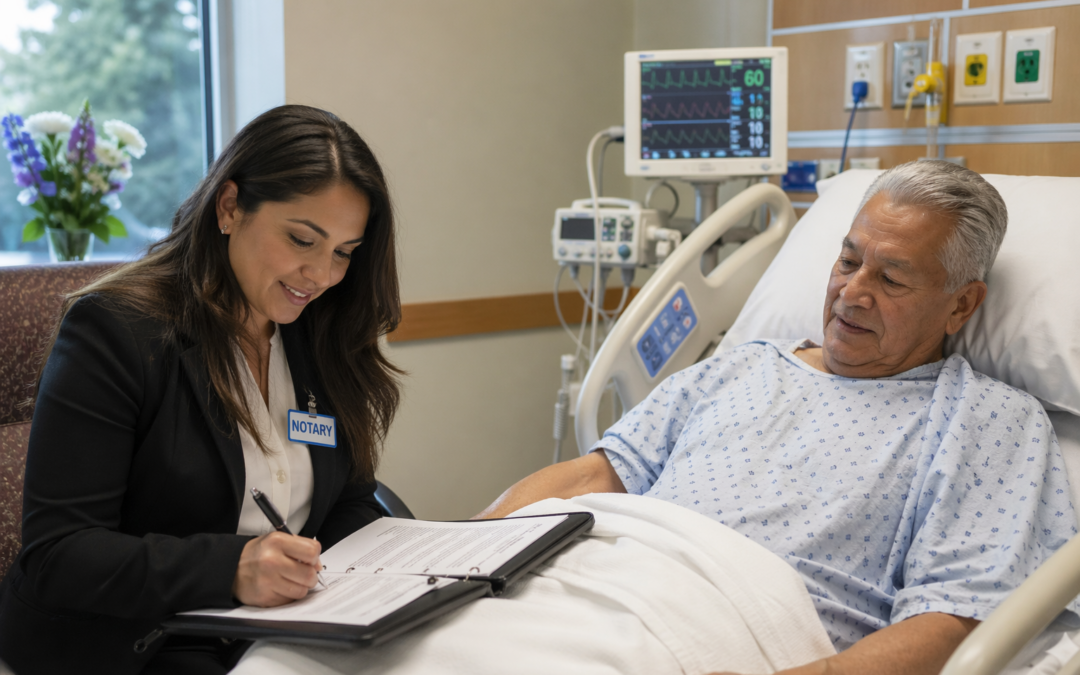
Hospital notarizations are not like office signings. The lighting is harsh. The bed is adjustable but the tray table wobbles. There are IV lines to work around. Furthermore, family members are emotional, and the patient is often exhausted, medicated, or both.
Here is what I assess the moment I walk in, every single time.
First and foremost, I confirm the patient is alert and oriented. California law requires the signer to be mentally competent and acting without duress. I am not a doctor, and I do not make medical diagnoses. But I do have a conversation with the signer, ask them to confirm what documents they are signing, verify that they understand what authority they are granting, and make sure nobody in the room is pressuring them. If anything feels off, I stop. I have a legal obligation to decline the notarization if the signer does not appear competent or willing.
At Kaiser Ontario that afternoon, the patient was clearly alert. He knew what he was signing. He also knew who he was naming as his agent. Most importantly, he understood that surgery was the next morning and that these documents needed to be in place before he went under anesthesia. His brother and sister-in-law were in the room, but they were not hovering or directing. Instead, they were simply relieved that someone had showed up who could actually help.
The Signing: Working Around a Hospital Bed
Once I confirmed competency, I shifted my focus to the physical logistics of the signing.
I positioned the documents on the tray table and adjusted the height so the patient could sign comfortably from his bed. Some hospital patients cannot hold a pen at all. In those cases, California law allows a signer to direct another person to sign on their behalf in the notary’s presence. Fortunately, that was not necessary here. He signed both documents himself.
After each signature, I completed the notary certificate and journal entry on the spot. Every signature gets a corresponding entry in my official notary journal, including the date, time, type of document, type of ID presented, and the signer’s thumbprint. This journal entry is a permanent legal record. More importantly, it is the backup that protects the family if anyone ever challenges the validity of these documents down the road.
The entire signing took about 30 minutes. Two documents. Two notarizations. One relieved family.
What Happened After: The Referral That Followed
After the signing, the family asked me something I hear more often than you might expect. A relative of theirs also needed documents notarized. Could I help?
This is what happens when you show up for a family at the hardest moment of their week. They remember you. Then they refer you. Not because of your Google reviews or your Yelp ad, but because you walked into a hospital room on a Tuesday afternoon, solved a problem nobody else could solve, and treated their family with respect.
That referral turned into another appointment. This is how Wet Ink Notary has grown since day one. You do right by people when it matters most, and as a result, they send you everyone they know.
If you need a hospital notary near me and you are at Kaiser Ontario, Pomona Valley Hospital, San Antonio Regional, Arrowhead Regional, Loma Linda University Medical Center, Riverside Community Hospital, or any other hospital in the Inland Empire, call Wet Ink Notary.
What Every Family Should Know Before Hospital Surgery
If someone you love is going into surgery, do not wait until the night before to think about legal documents. Here is what you should have in place before the procedure.
First, a durable power of attorney that names a trusted person to manage finances. Without one, your family cannot access bank accounts, pay bills, or manage insurance claims if the patient is incapacitated after recovery.
Second, an advance health care directive that names a health care agent and states the patient’s treatment wishes. Without one, medical decisions default to a hierarchy under California Probate Code section 4711, which may not reflect what the patient actually wants.
Third, a HIPAA authorization that allows family members to access medical records and communicate with doctors. Many hospitals will not share information with family members without this form on file.
Fourth, a living trust, if the patient owns real property or has significant assets. If the patient becomes incapacitated without a trust, the family may face a conservatorship proceeding that costs $5,000 to $10,000 or more. If you need a Trust Signing Notary In Ontario or Ontario Ranch or anywhere in the Inland Empire, Wet Ink Notary handles these regularly.
Most families do not have all four of these in place. If you are reading this because surgery is tomorrow, call me now. We can notarize the POA and advance directive today, and the trust and HIPAA authorization can follow afterward.
Call (626) 248-0349 — I answer evenings and weekends.
The Expired ID Rule That Saves Hospital Signings
This is worth repeating because it saves signings every month. Under California Government Code section 8230, the following IDs are acceptable forms of identification for notarization even if they are expired, as long as they were issued within the last five years:
A California driver’s license or state identification card qualifies. Similarly, a United States passport works under the same rule. A foreign passport stamped by U.S. immigration authorities is also acceptable within that window.
If the ID was issued more than five years ago and is expired, it is not acceptable, and the signer will need an alternative form of identification. However, within that five-year window, you are fully covered. Do not let anyone, including a hospital social worker or a nurse, tell you otherwise.
I knew this rule at Kaiser Ontario that afternoon. As a result, it saved that family’s signing. This is the kind of detail that matters when you are searching for a hospital notary near me and you need someone who will not waste your time or send you scrambling for paperwork you cannot get.
Frequently Asked Questions
Can a notary come to a hospital room?
Yes. A mobile notary like Wet Ink Notary travels to hospitals throughout the Inland Empire. This includes Kaiser Ontario, Pomona Valley Hospital, San Antonio Regional, and every facility in Los Angeles, San Bernardino, Riverside, and Orange Counties. The patient must be alert, competent, and signing of their own free will.
Can I notarize documents for someone in the ICU?
It depends entirely on the patient’s condition. If the patient is conscious, alert, and able to communicate clearly, a notarization is usually possible. On the other hand, if the patient is sedated, intubated, or unable to demonstrate understanding of the documents, I will decline. Patient safety and legal validity always come first.
What if the hospital patient cannot hold a pen?
California law allows a signer to direct another person to sign on their behalf in the presence of the notary. The notary documents this arrangement in the journal entry and on the certificate. This is called signature by mark or signature by direction, and it is legally valid under California law.
How fast can a hospital notary near me arrive?
Wet Ink Notary is based in Upland. For hospitals in Ontario, Rancho Cucamonga, Pomona, Fontana, and San Bernardino, I can typically arrive within one to two hours of your call. For hospitals further out in Riverside, Corona or Orange County, allow two to three hours depending on traffic and time of day.
How much does a hospital notarization cost?
California caps the notary fee at fifteen dollars per signature. Mobile travel fees are separate and depend on the hospital location, time of day, and urgency of the request. Call for a flat quote with no hidden charges.
Does the hospital need to approve the notary visit?
Most hospitals allow notary visits during regular visiting hours without any special arrangement. However, some ICU and restricted units require advance coordination with the nursing staff. Call the nurses’ station first, then call me. I will work around whatever schedule the hospital requires.
Book a Hospital Notary in the Inland Empire Today
When you search for a hospital notary near me, you need someone who shows up fast, knows California ID law, understands bedside signing logistics, and treats your family with respect during the hardest week of their lives. That is exactly what Wet Ink Notary does.
I have notarized documents at Kaiser Ontario, at <a href=”https://thewetinknotary.com/2025/07/09/mt-san-antonio-gardens/”>senior care facilities</a>, at kitchen tables, and at hospital bedsides across the Inland Empire. If your family needs documents signed before surgery, before a transfer, or before a deadline that will not wait, call me today.
Call: (626) 248-0349
Email: Brent@thewetinknotary.com
Website: www.thewetinknotary.com
Commission #2446864 • Process Server Registration #2006
Service Area
Serving Los Angeles • Orange • San Bernardino • Riverside – Counties
We travel to you for mobile notary and process serving appointments. Coverage includes local, extended, and long-range zones across Southern California.