
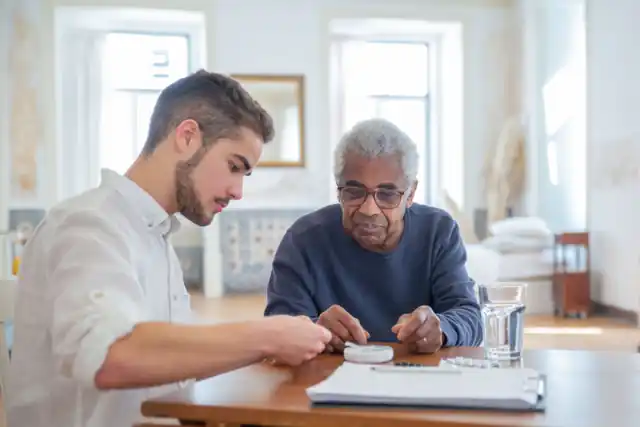
Families are often surprised by this one. If your mom, dad, or grandparent lives in a skilled nursing facility and needs to sign an advance health care directive, a notary stamp is not enough. California requires one more signature: a long-term care ombudsman or patient advocate. Skip it, and the directive is not effective.

Need a notary at a nursing home or assisted living?
We come to the resident’s room and schedule around the ombudsman when one is required.
What the law says
California Probate Code section 4675 says that if a person is a patient in a skilled nursing facility when they sign a written advance health care directive, the directive is not effective unless a patient advocate or ombudsman signs it as a witness. That signature can count as one of the two witnesses, or it can be added on top of notarization. The ombudsman also signs a statement that they are serving as the witness the law requires.
The reason is protective. People in skilled nursing care depend on staff for nearly everything, so the law adds an independent person to confirm the patient is signing freely.
Skilled nursing vs. assisted living
This rule only applies to skilled nursing facilities, sometimes called nursing homes or convalescent hospitals. It does not apply to assisted living or memory care communities licensed as residential care facilities for the elderly. In assisted living, a directive can be signed with two qualified witnesses or notarized, like anywhere else.
Not sure which kind of facility it is? Ask the front office whether it is a skilled nursing facility. The answer decides whether you need the ombudsman.
How to set up the signing
- Call the facility social worker. Ask them to contact your county’s Long-Term Care Ombudsman Program and request a witness for an advance health care directive.
- Pick a time for everyone. The ombudsman, the notary, and the resident need to be together. We will schedule around the ombudsman.
- Check the ID. The resident needs a current government photo ID, or one issued within the last five years. If not, ask us about credible witnesses.
- Choose an alert time of day. The resident must understand what they are signing. Many families pick mid-morning.
Who else can be a witness
If you use witnesses instead of, or in addition to, a notary, California limits who can serve. A witness cannot be the person’s health care agent, their health care provider, or an employee of that provider, and cannot be the operator or an employee of the care facility. At least one witness also cannot be related to the person or entitled to inherit from them. If you don’t have witnesses, we can bring them for $50 per witness.
A bill that may change the wording
In 2026, the Legislature considered SB 1189, which would leave the Department of Aging’s ombudsman as the only allowed witness and drop “patient advocate.” As of November 2026 it has not become law, so the current rule above still applies.
Frequently asked questions
Does an advance health care directive signed in a nursing home need an ombudsman?
Yes, if the person is a patient in a skilled nursing facility. California Probate Code 4675 says the directive is not effective unless a patient advocate or ombudsman signs it as a witness, even if it is also notarized.
Does the ombudsman rule apply in assisted living?
No. Assisted living communities are not skilled nursing facilities, so the ombudsman requirement in Probate Code 4675 does not apply. The directive can be signed with two qualified witnesses or notarized.
Is notarization enough by itself in a skilled nursing facility?
No. Notarization does not replace the ombudsman. In a skilled nursing facility you need the ombudsman or patient advocate signature in addition to the notary, or as one of two witnesses.
How do we get an ombudsman to the signing?
Ask the facility social worker to contact your county’s Long-Term Care Ombudsman Program, then schedule the notary visit for the same time. Plan ahead, because ombudsman schedules fill up.
Last updated November 2026. This article is general information, not legal advice. A notary public cannot prepare an advance health care directive or advise you on its contents. Talk to an attorney with questions about your situation. Wet Ink Notary LLC is not a law firm. Brent Hernandez, California Notary Public #2446864 and Registered Process Server #2006 (San Bernardino County).